
Tribes have governed their communities and people for thousands of years. Today, Tribes throughout Alaska continue to have Tribal Courts to serve their communities in areas of family matters, public safety, and protective orders. In working with Tribes, we have seen many Tribes struggle with questions around enforcement of Tribal court orders. This page explores ways Tribal Courts can enforce their orders. It focuses on civil fines, fees, or community service not on criminal laws. The page will discuss different ways that Tribal Courts can encourage individuals to comply with those orders and explain how tribal, state, and federal law may affect those methods. Here are some examples of situations of what the need for enforcement of Tribal court orders might look like:
1) A teenager broke the windows of a neighbor’s house. After a court hearing, the court ordered that the parents of the child help pay for repairs to the window, but the parents refuse to do so.
2) Someone has repeatedly violated a curfew ordinance and now owes hundreds of dollars in fines or many hours of community service but refuses to participate or pay the fine.
This page explains practical and legal options Tribes can use to enforce fines or court orders. Many of these suggestions are pulled from western law and some of them even rely on state courts. There may be other options including traditional or cultural paths for enforcement that we have not thought of. If you have other methods for enforcement of your Tribal orders that you think we should include here, please reach out to us.
Alaska Tribes do not have all the same enforcement tools as the State of Alaska. But Tribes and Tribal Courts still have many effective options. This document aims to set out a variety of options and ideas that we hope will help Tribal Court select the enforcement tools that are best suited to their community and culture.
This page does not address the issues of child protection, child custody, domestic violence or other family law matters. Tribal Court orders on these issues are generally given “full faith and credit” by the State of Alaska. For more information on “full faith and credit”, see AlaskaTribes.org’s “full faith and credit” explainer page.
Outside of criminal prosecution, many Tribes use civil fines or community service to address violations of Tribal law. But what happens if the person refuses to pay the fine or do the service?
In western law, punishments often serve three purposes. They may discourage future violations, require payment for the harm caused, or punish the person who broke the law. Just because this is how western courts are run; it may not always be the best option for your community. This document explains options a Tribal Court may use to enforce Tribal law in the community. For example, if someone violates the curfew or brings alcohol to a dry community, what could your Tribal Court do to address that issue.
These answers have been prepared by people trained in western legal systems and may offer only limited perspectives. There may absolutely be other traditional methods of healing or restitution that are better suited to your community.
This page does not address criminal violations (criminal violations means where the Tribal court may order someone to serve jail time) because to hold a criminal prosecution the Tribe must provide the defendant with additional procedural protections under the Indian Civil Rights Act. Those protections are both important and expensive. If your Tribe wants to explore criminal prosecution, it would be best to reach out to a tribal attorney.
A civil fine is a penalty given to someone for breaking a non-criminal law, rule, or code. These laws are usually made to keep the community safe and organized. For example, a local government may make a curfew in order to keep the community safe and if a person is out without an acceptable excuse after that time, they may get a fine. Civil fines can also be given for things like:
• Curfew violations
• Importing alcohol
• Polluting the environment
Civil fines are mostly meant to make sure people follow the law, but people who break civil laws still have rights. The community must be able to read the rules. For example, if curfew starts at 11 p.m., people must be informed that staying out later may lead to a fine. This allows people to know what the rules are so that they can follow them.
Also, people who get a fine have the right to “due process.” This means they should be told about the fine and have a right to a hearing where they can (if they want) explain to the Tribal court why they shouldn’t be fined. At the hearing, the person may say they did not break the law. Or that they did break the law, but the fine should be lowered or forgiven.
Practice tip – a person has a right to a hearing, but that does not mean there must always be a hearing. The person must get notice of their right to a hearing, but it is totally OK to only hold a hearing if the person requests it. The ticket or citation itself can tell them that and have a place where they could request a hearing. The person may not want one and that is ok. If someone agrees that they broke Tribal law and they are in agreement to pay the fee or do community service, then there is no need for a hearing. This would prevent a Tribal court from having to hold hearings where the person simply wants to pay the fine and be done with it.
Examples of this in western court could be a speeding ticket. While someone has the right to go to court and ask the police officer to prove that they were speeding, or ask for the fine to be reduced, alternatively, they can simply pay the ticket and not have a hearing.
A civil fee is a charge for a service to help cover the cost of that service. For example, if a car is parked illegally and needs to be towed, the city might charge a fee to the car owner to offset the cost of towing. If a person is taken to a community facility to sober up after being drunk in public, they could be charged a fee for staying there. The amount of the fee is usually written in the law. Fees usually don’t have due process requirements, but sometimes a person can appeal if they think the fee was charged unfairly.
Example fees: towing an illegally parked car, or housing a person for a night to help them sober up, cost money. A fee would charge money to the owner of the car, or the person who was housed, to help the community cover those costs.
Some western courts add small fees to civil fines or criminal convictions to help offset the cost of enforcement.
While fines and fees can help hold people accountable, they can also cause harm to individuals and the community. Fines and fees should encourage people to follow the law. They should not push people into poverty. But the cost of fines can make it hard for people and families to pay the rent and keep food on the table. In the worst cases, people who can’t pay fines or fees simply start ignoring them, leading to worse problems. This could ultimately cause more problems for the community than the original finable offense.
To avoid this, experts say that fines and fees shouldn’t always be the same for everyone. The law should set a maximum fine or fee. The actual amount should depend on what the person can afford to pay. Before charging a fee or fine, a tribal court should take the time to figure out what a person can afford to pay.
Many tribes let judges choose the option that best helps the community. In some cases, community service may be better than a fine.
For more information about the dangers of fines and fees see the National Center for Access to Justice’s (NJAC) report on “Fines and Fees in American Courts.”
For more information about how to determine a person’s ability to pay, see NJAC’s 2024 report “The Ability to Pay, our National Report on Policy Models for Determining Ability to Pay.“
Yes, absolutely. There are many ways to help the community that don’t just involve paying money but instead focus on building and supporting the community. The Tribe can define what counts as community service. Sometimes, activities that help a person grow or heal may also count as community service. A judge could require a person to complete a certain number of hours of service or to complete certain activities or tasks. Here are some examples:
• Traditional and Cultural Activities: Learning skills like hunting, fishing, beading, or participating in a dance group.
• Spending time with Elders: Learning about the community’s history and stories or spending time with a mentor.
• Community work: Helping with events, cleaning tribal buildings, or repairing community spaces. This could help people build skills and self-esteem while serving the community.
• Skills development: Gaining job experience working with professionals like carpenters, social workers, or community health aids. Some courts have even considered time spent studying for the GED as community service.
• Restitution: Helping fix damage done or organizing fundraisers to cover repair costs.
• Apologies: Writing or saying sorry to people affected by their actions.
These alternatives can help rebuild relationships, teach valuable skills, and connect people to the community.
If someone refuses to pay a fine, fee, or do community service, the Tribal Court can take actions to encourage them to follow the rules before the Court begins a debt collection process. Some actions the court might take include:
• Public Statements: The Tribe could tell the community what the person did and how much they owe. The name of the debtor and their debt could be posted in a public place in the community. Note that different communities and cultures may interpret a “public shaming” like this in different ways. Also, while it might convince some people to pay, it could make other people more determined not to pay.
• Restrictions on Services: Limiting access to Tribal services, like community events or certain benefits programs. However not all services can be suspended:
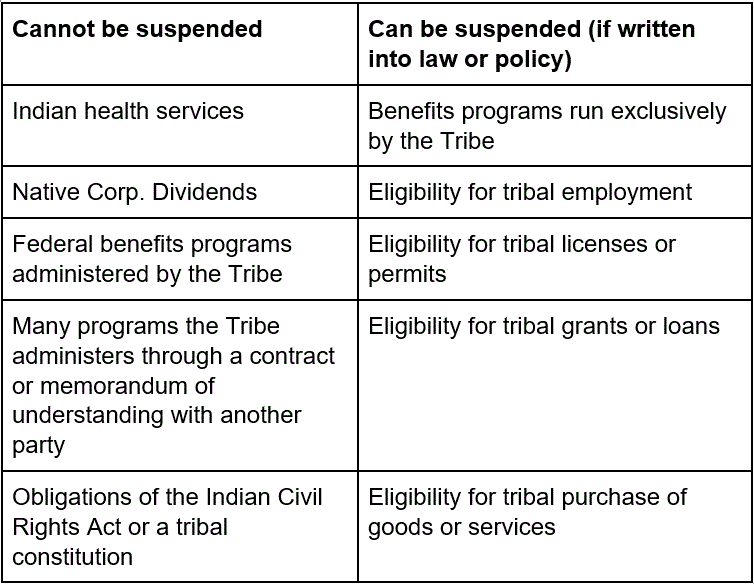
Some services or funds may have rules that prevent the Tribe from suspending them. If you are suspending a service and unclear if it is allowable, you should speak to an attorney to make sure the Tribe would not be violating any terms for that service.
• Alternative collection: The court could allow the debtor to give food, goods, or access to special equipment instead of money. The Tribe could distribute these goods to needy families or consider it community service.
These actions could also apply to someone found to be in civil contempt of court.
Courts have the power to encourage compliance with court orders. If someone (who has been given due process and where the Tribe has jurisdiction) ignores a court order, that can undermine the court’s authority. This is a problem faced by courts around the world. Civil contempt of court is a tool western courts use when someone ignores a court order. The court may add consequences to push the person to comply.
Fines are the most commonly used tool to encourage compliance although in serious cases, the court may even order detention until an order is complied with.
Civil contempt works differently in different courts. But generally, the party harmed by the non-compliance requests a contempt finding from the court, or the court itself begins the process. The U.S. Supreme Court says civil contempt requires basic due process. This includes notice of the hearing and a chance to respond. In western courts, we call this a “show cause” hearing where the party who isn’t complying has an opportunity to prove to the court that their behavior was not willful or intentional. If the court finds that the party has willfully or intentionally not complied, then it can impose additional sanctions to force compliance.
In Alaska state courts, for example, disobedience of a lawful judgment or order can result in a fine of up to $100 or $300 (depending on the conduct) and imprisonment for up to 6 months. Alaska State Courts also have the power to suspend state driver’s licenses or hunting and fishing licenses.
A Tribe can establish an ordinance on what contempt of court is in their Tribal court. Specifically, the Tribe can order that violations of court orders may result in a fine if the person does not have a good reason for why they did not comply with a court order. Examples of good cause may include being unable to show up for court (for example in the hospital during the hearing) or another good reason as determined by the Tribal court.
Contempt of Court is, of course, only helpful if the Tribe can enforce a Tribal order (i.e. get someone who may not want to do so to pay a fine or otherwise comply with a court order).
Yes, a Tribal Court judgment that someone owes money can be used to collect that debt within the tribal community. The difficulty is finding and accessing the money. But certain situations are possible, for example, if the person is supposed to get money from a Tribally run bingo game, that money could be taken to enforce the tribal judgment.
However, there are limitations:
Funds from federal benefit programs managed by the Tribe usually can’t be taken.
There need to be Tribal laws that give the court the power to collect such money and set the rules for doing so.
It’s a good idea to give the debtor notice before any collection happens. For example, on the order issuing the fine, the Tribe could note that it may collect unpaid money from bingo winnings in the above example.
Another option is to work with a debt collector. The debt collector may accept the Tribe’s order as proof of the unpaid debt, then try to collect the money from the person. At this time, we do not know if any of the debt collection companies in Alaska would be willing to do that but the Tribe could request it. This could push the person to pay the debt. If they do not pay, their unpaid debt could hurt their credit score.
If the Tribe is considering collecting a debt locally for the first time, it would be a good idea to consult with an attorney.
The Tribe could consider other creative options to encourage people to comply with a Tribal court order. Several ideas are:
• Posting the names of people (adults only) who have violated Tribal law with the outstanding money owed in a public place.
This may encourage people to pay outstanding fines to the Tribal Court in order to avoid this sort of community attention.
• Writing a letter to a person’s employer requesting that a portion of a person’s wages are sent to the Tribal Court from each paycheck may be an option
The Tribe can’t require an employer to do this but can request. Unless the employer is the Tribe itself. For non-tribal employers, garnishing on behalf of a Tribal court could be violating state law.
It may help if a person was to sign a document agreeing that a portion of their paycheck would go to the Tribal court instead of to them. Or if that agreement was written in to the employee’s contract.
• Providing notice to people that if they do not comply with the court’s fines and owe more than a certain amount, the Tribe may seize their ATV, Snowmachine, or boat until the fine has been paid (or another arrangement has been met by the Tribal Court).
If the Tribe was to do this, the Tribe would want to ensure that the property could be kept safe until the fine was paid
It is more complicated if the person does not own the property (i.e. there is still a lien on the boat from purchase).
If the person uses the property in order to go to work and not having it prevents them from earning money, it can make it harder for them to make money to pay a fine (that may be bad policy).
• One creative idea a Tribe used was to ask the store to restrict certain purchases for someone who has been convicted of making homebrew. Specifically, they would ask the store to limit the purchase of things like grapefruit juice or other specific things that people were using to make alcoholic beverages.
If an Alaska state court recognizes a Tribal Court judgment, the Tribe may be able to use state collection tools. These can include liens and garnishment of wages or Permanent Fund Dividends(PFDs).
However, it’s not clear if this has ever been done before. Here’s what we know:
Alaska courts have rules in place to recognize only certain types of Tribal court orders, like child protection or child support orders. A Tribal court judgment for money would not follow those rules. Instead, the state court would likely apply the “comity” rule. Comity is simply a fancy legal word for one court agreeing to enforce the decision of another court. AlaskaTribes.org has an explainer about comity and full-faith and credit. A Tribal court order may be given comity by an Alaska State court if the Tribal order meets three standards:
• Jurisdiction: The Tribal Court must have had the right to hear the case.
• Due Process: The person must have had a fair hearing.
• Public Policy: The judgment must not go against U.S. or Alaska state laws.
Before trying to collect a debt, ask one practical question: Does the person have money or income to pay it? For example, if the person the Tribe is attempting to collect money from does not have a job and is supposed to pay for child support, it is very likely all the money from their PFDs will be gone prior to reaching a debt from the Tribe (child support is always taken first from the PFD prior to other debt under state law). There is no way for the Tribe to know how much money a person may have prior to entering into these processes.
If a tribe wants to try this, it’s a very good idea to talk to tribal legal counsel first. In the legal world, when something is done for the first time, it is important to do it well.
Note that native corporation dividends cannot be garnished through this process. The Alaska Supreme Court determined in 1977 that Federal Law limits collection of native corporation dividends to only child support payments (Calista Corp. v. DeYoung,Calista Corp. v. DeYoung, 562 P.2d 338 (1977)).
Federal courts have found three main ways that a Tribal court can have jurisdiction over a non-native:
• The person agrees to follow Tribal law.
• The person has a long-term relationship with the Tribe or its citizens.
• The person is doing something that threatens the Tribe’s existence.
If a Tribe takes legal action against a non-Native person, and that person claims the Tribe does not have jurisdiction over them, that person usually must challenge the Tribe’s jurisdiction during the case. If they do not, they may lose the chance to raise that argument later. The person must also appeal in tribal court.
A non-Native person may only be subject to a Tribal civil fine if one of the three jurisdiction rules applies. However, businesses or people who have a contract with the Tribe or live in the community might still be subject to Tribal laws:
• Consent can be a powerful tool for jurisdiction. Many tribal interactions with outside businesses or people are done through contracts. But a contract with a business or employee that does work for the Tribe could include a clause about following Tribal laws. So could a lease agreement for a non-tribal tenant in tribally run housing.
• Long-lasting relationships are also important to consider. The Tribe likely has jurisdiction over non-natives who are living in the community and married to tribal members or adopting children who are tribal members. Similarly, businesses that operate with the Tribe and its members for years might fall under the Tribe’s jurisdiction, particularly if the business has a physical presence in the community.
• Civil fees are useful here because a fee is essentially a charge for a service. If a non-native illegally parks a car that gets towed, a tribe would have a strong argument that it has jurisdiction to enforce a towing fee because the person chose (“consented”) to, for example, ignore the no parking sign which explained Tribal laws.
• Civil fines for violating a Tribal non-criminal law, regulation, or code might only be enforceable against a non-native if the person or business meets one of the three jurisdiction reasons above. But a contract with a business or employee that does work for the Tribe could include a clause about following Tribal laws. So could a lease agreement for a non-tribal tenant in tribally run housing.